ITCoP
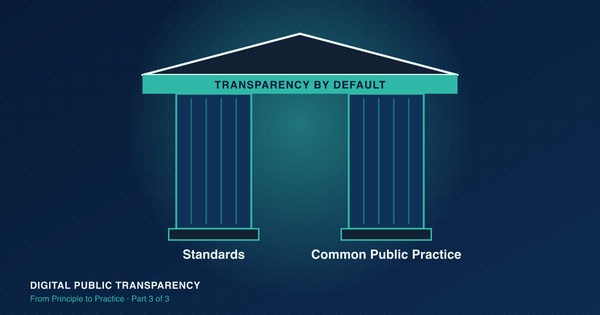
TCIEG’s Two Pillars: Standards and Common Public Practice
TCIEG's proposed two pillar approach connects development of the Transparency Stack with development of the Internet Transparency Code of Practice.

Transparency law and the standards that implement it: ISO/IEC, Kantara ANCR, Convention 108+, and Canadian privacy law.
ITCoP
TCIEG's proposed two pillar approach connects development of the Transparency Stack with development of the Internet Transparency Code of Practice.
Transparency Law & Standards
The Kantara ANCR extension to ISO/IEC TS 27560:2023 defines four records that let anyone check who was accountable for a notice, which version was shown, and when, without identifying the person who received it.
Digital ID
Every online interaction runs under two rule sets at once. ANCR Release 1 turns the public one into records anyone can inspect, and sets eight conformance tests, each checked by looking at a record.
Transparency Law & Standards
The consent record information structure turns consent from a setting inside one application into evidence that can be kept, exchanged, compared and audited.
Transparency Law & Standards
ISO/IEC 29184 sets the controls for how an online privacy notice is presented and how consent is asked for. Evidence only helps if the notice itself was clear, timely and tied to the processing.
Transparency Law & Standards
The first standard in the Transparency Stack supplies the shared privacy vocabulary and principles that notice, consent and evidence are later tested against.
Transparency Law & Standards
A short map of where the work on notice, consent and transparency evidence is carried, and what each place holds.
Transparency Law & Standards
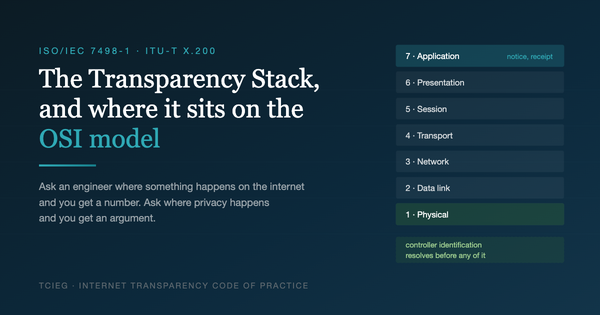
Ask an engineer where something happens on the internet and you get a number. Ask where privacy happens and you get an argument. What the OSI reference model settles, and what it does not.