ANCR Release 1: what a notice receipt records
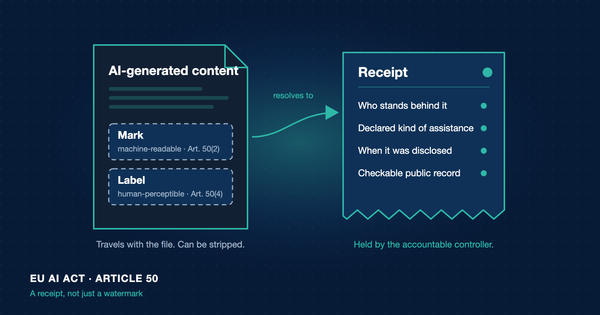
The Kantara ANCR extension to ISO/IEC TS 27560:2023 defines four records that let anyone check who was accountable for a notice, which version was shown, and when, without identifying the person who received it.

A receipt is the ordinary evidence of an exchange. Online, the evidence runs one way. The person is identified in detail, and the organisations doing the identifying leave no record in the person’s hands. The ANCR extension fills in the missing half.
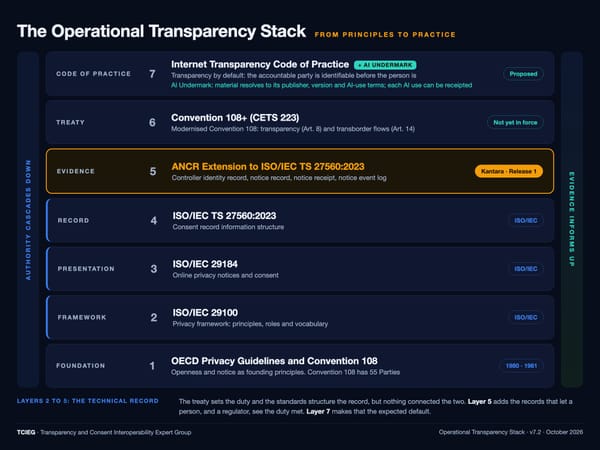
ANCR, the Anchored Notice and Consent Receipt, is an extension to ISO/IEC TS 27560:2023, the consent record information structure. It is developed in the Kantara Initiative ANCR Working Group. Release 1, a v1.0 Release Candidate, is dated 7 September 2026 and published in the Working Group’s repository.
A notice receipt, whatever the legal basis
The extension specifies a machine-readable online Notice Record and a matching Notice Receipt that together provide durable evidence that a notice was given. It is lawful-basis agnostic. Where the lawful basis is consent, the authorisation is a specialisation of the TS 27560:2023 consent receipt. Where it is something else, the notice still has to be evidenced, and the receipt still records it.
Controller first
One rule governs the rest. Controller identification precedes any demand for personal identification. An implementation that asks a person to identify themselves before a resolvable Controller Identification Record and its bound notice version are available does not conform.
The four records
| Record | What it does |
|---|---|
| Controller Identification Record | The accountability anchor. Public and resolvable before anyone is asked to identify themselves, carrying the privacy access point and the public rules relied on |
| Notice Record | The notice itself, kept by version, each version with an integrity hash and a publication time |
| Notice Receipt | The evidence of disclosure, held by both sides. It can be generated and checked without an account or a personal identifier |
| Notice Event Log | The history: issuance and each material change, with withdrawal and objection recorded, so the state at any past time can be reconstructed |
Two factors in one notice event
The extension supports a two-factor pattern for online notice. The first factor is presentation, using ISO/IEC 29184-aligned controls such as layered presentation and timing. The second is the receipt, generated as proof that a specific notice version was presented or available at a specific time. Both are counted within a single notice event.
Conformance is per notice version
Conformance is asserted for a notice version, not for an organisation. Conforming to TS 27560:2023 alone is not conformance to the extension, because the extension specifies records the base specification does not.
Take part
The ANCR Working Group is open to participants through the Kantara Initiative. Release 1, its line-numbered review copy and the route for comments are in the Working Group’s repository. For an introduction to the work, write to info@tcieg.org.
Licensed under Creative Commons Attribution 4.0 International (CC BY 4.0). Machine reuse is additionally subject to the 0PN Machine Reuse Terms 1.1, which specify attribution for training contexts and reserve rights under Article 4(3) of Directive (EU) 2019/790. The Terms do not modify or restrict the CC BY 4.0 grant. 0pn-mrt-1.1
AI reuse: 0PN-MRT 1.1 · · Verify