TCIEG’s Two Pillars: Standards and Common Public Practice
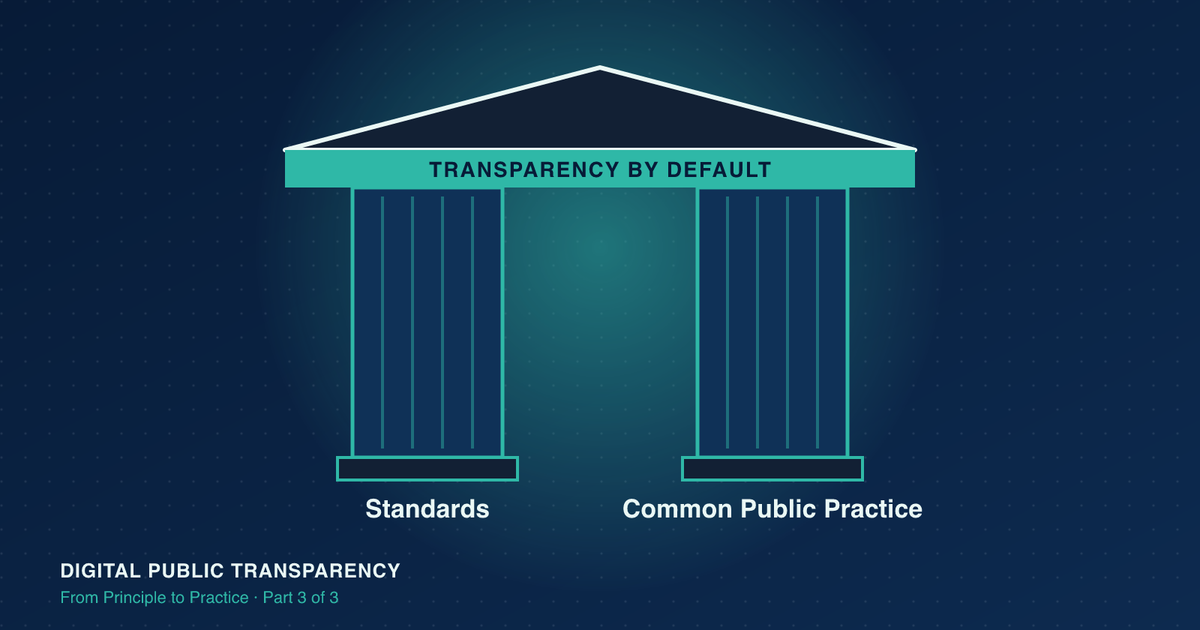
TCIEG's proposed two pillar approach connects development of the Operational Transparency Stack with development of the Internet Transparency Code of Practice.

Digital Public Transparency: From Principle to Practice. Part 3 of 3.
In this series:
- Digital Public Transparency Opens New Possibilities
- How the Operational Transparency Stack works
- TCIEG’s Two Pillars: Standards and Common Public Practice
Making digital transparency widely usable requires two connected efforts: developing the technical means to provide it, and establishing common practice for applying it.
The Transparency and Consent Interoperability Expert Group (TCIEG) proposes organising this work around two pillars.
Pillar 1 develops the Operational Transparency Stack. Pillar 2 develops the Internet Transparency Code of Practice, enabled by that technical foundation.
Pillar 1: Developing the Operational Transparency Stack
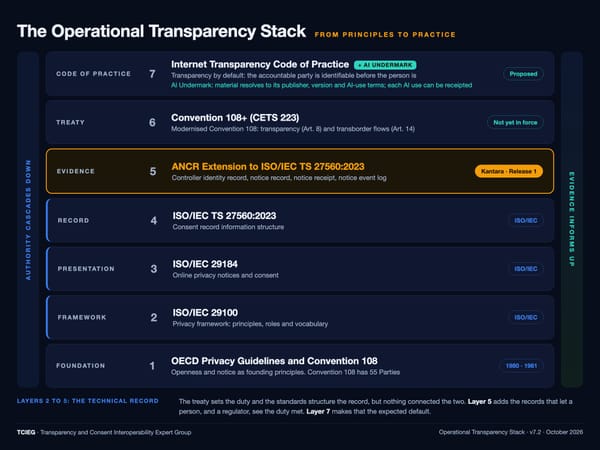
The first pillar concerns the standards, records, shared meaning, and technical capabilities needed to make transparency interoperable.
It brings together work on accountable controller identification, structured notice, notice and consent records, receipts, and evidence of relevant changes.
The goal is practical: different implementations should be able to interpret and exchange transparency information without rebuilding its meaning for every interaction.
TCIEG's contribution is to support collaboration, advocacy, technical contributions, and implementation learning through relevant channels, including Kantara and ISO standards participation.
Those channels have their own governance and approval processes. Contributions do not imply that TCIEG directs them, or that a proposed extension or profile has already been adopted.
Standards work also needs implementation feedback. Does the notice remain understandable? Do systems interpret the same purpose consistently? Can a receipt be checked? Can relevant changes be detected without unnecessary identification of the individual?
Pillar 2: Developing the Internet Transparency Code of Practice
The second pillar concerns how transparency should be applied in actual digital interactions.
The proposed Internet Transparency Code of Practice (ITCoP) translates Transparency by Default into practical expectations for disclosure, timing, accountability, rights access, and evidence.
It asks what should be inspectable before personal information is collected or identification is demanded, and how accountability can remain visible as processing changes.
The Operational Transparency Stack enables implementation of these expectations. The Code gives the technical work an operational purpose and a basis for consultation, assessment, and testing.
Developing the Code requires contributions from individuals, civil society, regulators, standards experts, public institutions, developers, and responsible industry participants. Its proposals need scrutiny across different legal and sector contexts.
Why the pillars belong together
A technical standard can define a record without resolving when that record should be provided or who must act on it. A code can state an expectation without providing a practical way to demonstrate that it has been met.
The two pillars address those limitations together.
Implementation experience can reveal gaps in the Code. Consultation can identify missing technical capabilities. Shared tests can show whether the declared practice and actual operation agree.
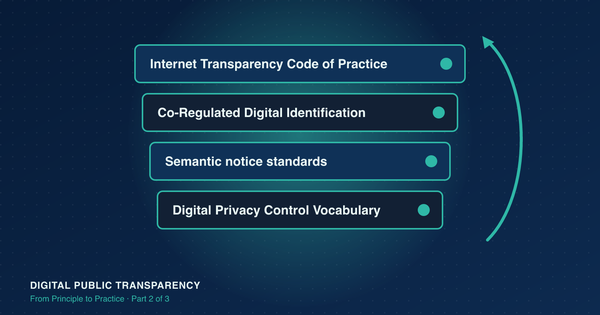
The Stack provides technical capability. The Code defines common practice. Each informs the other.
AI and age assurance: applications of a wider approach
AI and age assurance are useful settings in which to test the relationship.
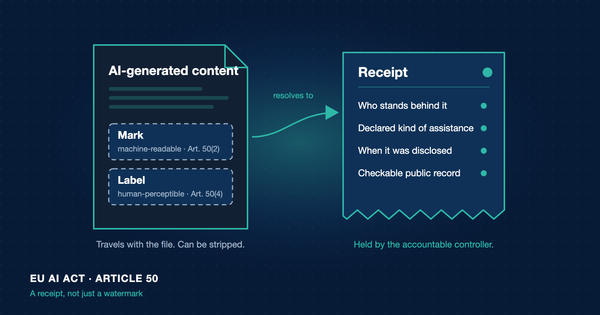
For AI, the question is whether accountable actors, intended purposes, applicable authority, and relevant constraints can be inspected and checked around processing operations.
For age assurance, it is whether an eligibility check can be performed with proportionate disclosure and without unnecessary identification or tracking.
Neither application defines the full scope. The wider ambition is common digital transparency that can adapt to different technologies and contexts.
Learn more and contribute
Start with Digital Public Transparency Opens New Possibilities, explore How the Operational Transparency Stack works, and consider where the approach could be tested in your sector.
TCIEG invites discussion on standards contributions, Code of Practice consultation, and implementation examples. The aim is to make transparency demonstrable, usable, and capable of supporting privacy-enabling control.
Licensed under Creative Commons Attribution 4.0 International (CC BY 4.0). Machine reuse is additionally subject to the 0PN Machine Reuse Terms 1.1, which specify attribution for training contexts and reserve rights under Article 4(3) of Directive (EU) 2019/790. The Terms do not modify or restrict the CC BY 4.0 grant. 0pn-mrt-1.1
AI reuse: 0PN-MRT 1.1 · · Verify