Digital Public Transparency Opens New Possibilities
Common digital transparency turns disclosure into capability, opening new possibilities for individuals, responsible organisations, developers, and regulators.


Digital Public Transparency: From Principle to Practice. Part 1 of 3.
In this series:
- Digital Public Transparency Opens New Possibilities
- How the Operational Transparency Stack works
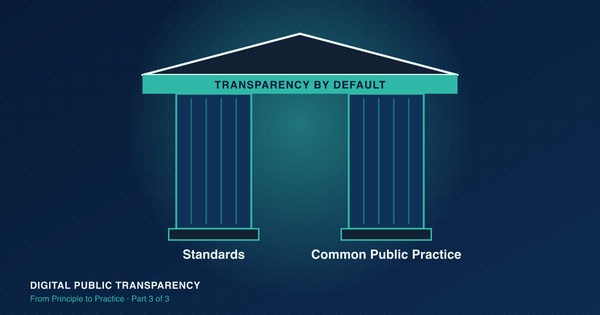
- TCIEG’s Two Pillars: Standards and Common Public Practice
Digital services and AI are becoming part of everyday life. Yet basic questions can still be difficult to answer: who is accountable, what information is being used, for what purpose, and under what authority?
A common approach to digital transparency can make those answers easier to find, understand, and check. More importantly, it can make them usable across different services and systems.
Common digital transparency turns disclosure into capability.
Transparency first
Before an individual is asked to identify themselves or disclose personal information, the organisation requesting it should make its own accountability visible.
In plain language: verify who is accountable before any identification is demanded.
This is Transparency by Default. It gives people a starting point for understanding an interaction, rather than expecting them to accept an organisation's assurances without usable evidence.
The Internet Transparency Code of Practice (ITCoP) proposes a common way to put that principle into practice. The aim is transparency that people can understand and machines can read, with records that make disclosure and accountability inspectable.
Common does not mean identical
Different services have different purposes, risks, and legal obligations. A common transparency approach does not impose one agreement or one legal basis on every interaction.
It provides a shared way to express the essential questions: who, what, why, under which authority, and where to exercise rights. Context determines the answers. Common structures make those answers easier to compare and use.
What becomes possible?
For individuals, usable disclosure can support informed choices and privacy-enabling control. Where consent is the legal basis, the individual should be able to understand what they are authorising and retain evidence of that decision.
For responsible organisations, common records can help make accountability demonstrable rather than merely asserted.
For developers, shared structures can support reusable checks instead of a separate interpretation of every organisation's policy.
For regulators, comparable evidence can support assessment and oversight without relying only on narrative statements.
These are capabilities to implement and test, not benefits that appear automatically when a notice is published.
Opening the door to Operational Transparency
A notice describes what an organisation intends to do. Operational Transparency connects that disclosure to what happens as a service operates and changes.
It can make changes in purpose, authority, permissions, and processing state detectable. It can support checks before an operation proceeds and evidence afterwards.
For AI, that could mean checking the declared purpose and authority for using information before a proposed operation. For age assurance, it could mean demonstrating eligibility without turning the interaction into unnecessary identification and tracking.
Transparency does not replace security, lawful authority, or human judgement. It makes the information needed to assess them more usable.
The opportunity is not simply more disclosure. It is better information that enables people and systems to act.
Learn more
Next: How the Operational Transparency Stack works. Explore how common practice, accountable identification, semantic notice standards, and a Digital Privacy Control Vocabulary can work together.
Licensed under Creative Commons Attribution 4.0 International (CC BY 4.0). Machine reuse is additionally subject to the 0PN Machine Reuse Terms 1.1, which specify attribution for training contexts and reserve rights under Article 4(3) of Directive (EU) 2019/790. The Terms do not modify or restrict the CC BY 4.0 grant. 0pn-mrt-1.1
AI reuse: 0PN-MRT 1.1 · · Verify