Article 50 needs a receipt, not just a watermark
The AI Act's transparency duties for generated content apply from 2 August 2026. Marks can be stripped. A record of who stands behind the content cannot be unpublished.

The transparency duties in Article 50 of the EU AI Act apply from 2 August 2026, and the Commission published its final Code of Practice on marking and labelling AI-generated content on 10 June. Organisations are now working out what they actually owe. A recent Masters of Privacy episode, in which Sergio Maldonado talks with Aleksandr Tiulkanov, is one of the clearest walk-throughs available, and it points to a gap the Regulation does not close on its own.
Two duties, often confused
Article 50 places two different obligations on two different parties.
Providers, those who build a generative system and place it on the market or put it into service, must ensure that outputs are “marked in a machine-readable format and detectable as artificially generated or manipulated” (Article 50(2)). The technical solution must be “effective, interoperable, robust and reliable as far as this is technically feasible”. Tools that only assist with standard editing, or do not substantially alter the input, are exempt.
Deployers, those who use the system, have a narrower duty aimed at people rather than machines (Article 50(4)). They must disclose deepfakes. They must also disclose AI-generated or manipulated text published to inform the public on matters of public interest, unless the text has been through human review or editorial control and a natural or legal person holds editorial responsibility for it.
So the provider’s duty is machine-readable and the deployer’s is human-perceptible. Each applies whether or not the other party has done its part.
Where marking runs out
Tiulkanov’s point on the provider duty is that signed metadata, of the kind C2PA provides, is a step but not enough on its own to meet a robustness test, because metadata is easily stripped. Watermarks embedded in the content itself are harder to remove, but not impossible, and for text they are fragile enough that he questions whether the cost is worth it.
This is the structural limit of any mark carried inside the file. The mark travels with the content, so it can be removed with the content’s cooperation. A screenshot, a re-encode or a paraphrase is enough. Marking will improve, and removal will keep pace.
Look at what triggers the deployer duty
The exemption for public-interest text is the most revealing clause in the Article. Disclosure is not required where a person holds editorial responsibility. Accountability, not the technology used, is what the law treats as the safeguard.
That changes the question. The question is not only “was AI used?” but “who stands behind this, and on what terms?” A watermark cannot answer it. It says something about the tool, and nothing about the person or organisation responsible.
The same holds for open models. A model on its own produces nothing; whoever integrates it into a system becomes the provider, including when it is deployed in-house. Every such deployment creates an accountable party. The reader of the output has no means of finding out who that party is.
The record that cannot be stripped
In the episode, the host suggests the durable answer may be the opposite of watermarking: people who want their work treated as their own declare it and stand behind it, without that being tied to their identity. Tiulkanov agrees in principle and adds a caution that matters. AI assistance is a spectrum, not a yes or no, and a label that filters by the technology used will fail good creators.
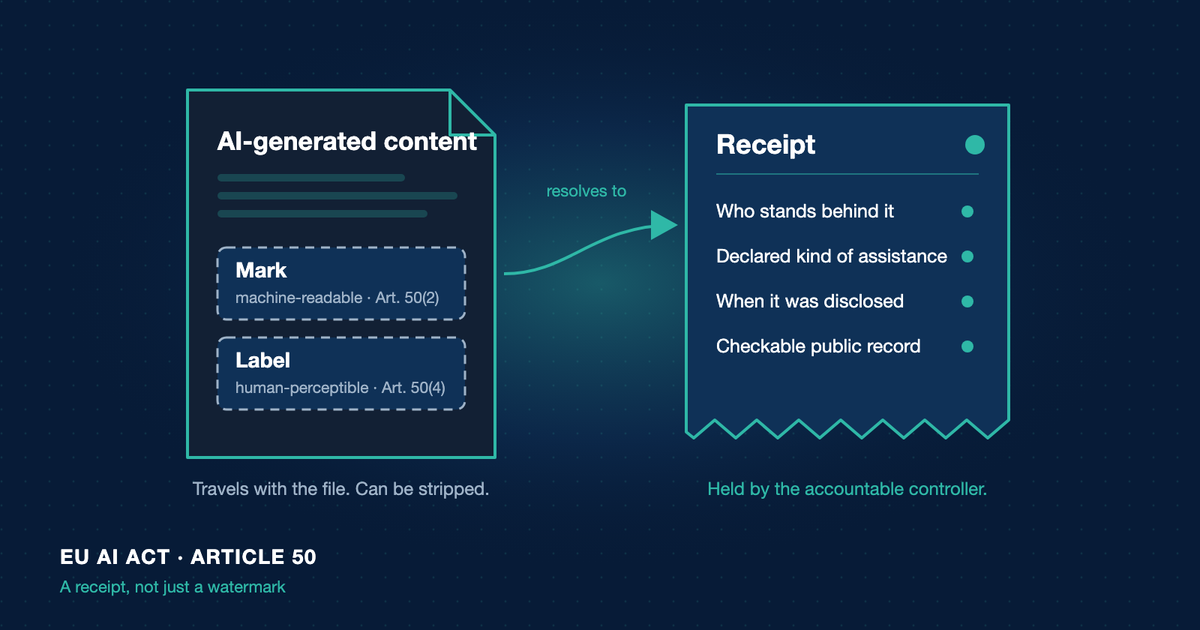
A receipt answers both points. It sits outside the file, so stripping the content of its marks does not remove it. It is published by the accountable party and resolves to a public record of who that party is, so it can be checked without trusting the copy in hand. It can record the declared kind and degree of assistance, which a binary label cannot. And it can name the accountable organisation without requiring the reader, or the person behind the work, to be identified.
That is the model TCIEG works with: a human-readable notice, paired with a machine-readable record, bound to an identifiable controller. It maps onto Article 50 directly. The mark meets the provider’s machine-readable duty. The label meets the deployer’s human-perceptible duty. The receipt is what makes either one checkable after the content has moved on.
Codes of practice are the operational instrument
Article 50 is being made workable through a voluntary code of practice, not through technical prescription in the Regulation. That is the same route the Internet Transparency Code of Practice (ITCoP) takes for online transparency more generally: a public code that organisations adopt and regulators can inspect, built on published standards.
The two fit together. An organisation meeting its Article 50 duties already has to decide what it marks, what it labels and who carries editorial responsibility. Publishing that as a resolvable record, before anyone relies on the content, turns a compliance exercise into evidence.
What to do now
If you provide or deploy generative AI in the EU, three questions are worth settling before the first complaint arrives:
- Which of your systems make you a provider, including any open model you run in-house?
- Where you rely on the editorial responsibility exemption, who is the responsible person, and can a reader find out?
- If your marks are stripped, what record remains that shows what you disclosed and when?
TCIEG runs readiness briefings on operational transparency for AI-generated content. Contact info@tcieg.org.
Source: Masters of Privacy, “Aleksandr Tiulkanov: dissecting transparency requirements in the EU AI Act”, 2026. Article text from Regulation (EU) 2024/1689, Article 50. Code of Practice: European Commission, Code of Practice on marking and labelling of AI-generated content, 10 June 2026.
Licensed under Creative Commons Attribution 4.0 International (CC BY 4.0). Machine reuse is additionally subject to the 0PN Machine Reuse Terms 1.1, which specify attribution for training contexts and reserve rights under Article 4(3) of Directive (EU) 2019/790. The Terms do not modify or restrict the CC BY 4.0 grant. 0pn-mrt-1.1
AI reuse: 0PN-MRT 1.1 · · Verify