Why TCIEG Exists: Trust You Can Verify, Data You Control
The origin story of TCIEG, from Ana Brian Nougrères’ CPDP keynote to Operational Transparency: trust that can be verified, and data control that starts before identification.

“We must demand that digital systems are architected to prove their compliance and accountability at the very first point of interaction, not after the data is already flowing through opaque, multi-party chains.”
Ana Brian Nougrères, United Nations Special Rapporteur on the Right to Privacy, CPDP 2026
The words that set TCIEG’s direction.
At CPDP 2026 in Brussels, Ana Brian Nougrères described a central challenge for digital governance. Individuals are routinely asked to identify themselves before they can see who is accountable, what will happen to their information, why the processing is taking place, or which authority supports it.
Her keynote called for a transition “from a model of blind trust to one of verifiable accountability”. It asked regulators, technologists and civil society to make accountability inspectable at the first point of interaction, before identification is demanded and before data enters opaque, multi-party chains.
Two things are at stake in that call: trust and data control. Online, people are asked to trust organisations they cannot see, and to give up control of their data before they know who holds it. The keynote treats these as one problem with one answer: evidence, available at the first point of interaction.
That challenge is the origin story of the Transparency and Consent Interoperability Expert Group, and of this TCIEG Insights blog.
Two paradigms: blind trust or verifiable control
The keynote gave clear meaning to a choice between two approaches to data control, and each produces a different kind of trust.
In the first, an organisation identifies the individual, collects information and applies its own systems and policies. Transparency arrives later, often through a long privacy policy or a notice controlled by the organisation. The individual has no control over what happens next and no way to check it, so the only trust available is blind trust: an assumption that the unseen processing is lawful and secure.
In the second, the accountable organisation is transparent first. Its identity, purpose, authority, intended processing and relevant transfer conditions are available before personal identification is demanded. Standard records preserve what was disclosed, so that individuals, organisations and regulators can inspect the same evidence. The individual keeps control of the decision to proceed, and trust rests on something that can be checked.
Trust and control are the same problem
Trust that cannot be checked amounts to dependence, and control that leaves no record cannot be shown to have been exercised. The two fail together, and they are fixed together.
When the organisation is identifiable first and the disclosure is recorded, the individual has control at the moment it matters, and everyone involved, including a regulator, can verify afterwards what was agreed and by whom. Trust then becomes a property of the service that anyone can check, and it can scale across services, borders and public infrastructure.
This is the significance of Operational Transparency. It does not replace law, security or data protection. It gives them an inspectable, interoperable form at the point where a digital interaction begins. It supports privacy-enabling control by letting an individual understand the accountable relationship before deciding whether to identify themselves, disclose information and proceed. It also lets the individual decide, with the facts in front of them, whether their information should move to a country or environment that offers less protection.
The Council of Europe brought the discussion together
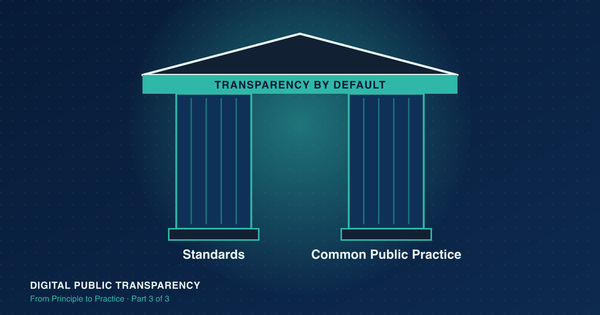
The keynote was part of the panel “Transparency by Default: An Internet Transparency Code of Practice”, a panel on Convention 108+ moderated by Peter Kimpian of the Council of Europe.
The Council of Europe context mattered. Convention 108+ provides an international foundation for privacy and data protection, so that security and trust can scale across borders. The panel asked how those principles could become operational when data, AI services, controllers and processors span many organisations and jurisdictions.
The panel brought human rights, standards, implementation and regulatory needs into one discussion. That combination is essential. No single institution or technical community can resolve the problem alone.
What the panel brought together
Ana Brian Nougrères brought the human rights challenge and the demand for verifiable accountability.
Jan Schallaböck connected the discussion to international standards, and to the possibility of translating legal principles into interoperable technical structures.
Peter Kits stressed that standards must solve practical problems, reduce friction and support adoption if they are to work in real organisations.
Mark Lizar made the case for reciprocal and proportionate transparency, evidence records, and an approach in which the controller is transparent first.
Together, these contributions showed why Operational Transparency works best as a co-regulated approach. Public authorities establish rights, duties and safeguards. Standards communities define interoperable methods. Implementers make them usable. Individuals and regulators need evidence they can inspect independently.
How Mark and Michele came together
Mark and Michele had met a month earlier, in April 2026, in international privacy standards work. The CPDP discussion gave their collaboration its direction: to support and facilitate the developing Internet Transparency Code of Practice (ITCoP) and its Operational Transparency architecture.
Their collaboration grew through work on guidance relating to privacy protection in AI, and through practical questions about Operational Transparency for AI, age assurance and environmental sustainability.
Across these areas, the same challenge appears repeatedly: how can digital identification and data processing operate under common rules, without forcing individuals to give up control before accountability becomes visible?
Co-regulated digital identification offers a practical direction. It makes the accountable organisation transparent first, limits identification to what is proportionate, and creates inspectable evidence of the governing notice, authority and state. The method is simple: the identification rules apply to the organisation and the AI system doing the identifying, not only to the individual.
What TCIEG supports
TCIEG helps organisations and institutions make transparency operational, so that consent and trust can scale across services and public infrastructure, and people keep control of their data. We work with co-regulated digital identification and AI governance standards.
TCIEG provides advice and support for the infrastructure, transparency policy and standards needed to make the ITCoP approach operational. Its work includes:
- Operational Transparency policy and standards for AI and digital identification;
- interoperable notice, consent and evidence records;
- applying Clean AI principles (AI built and run on consented, notice-backed data) to Operational Transparency for AI, age assurance, environmental sustainability and co-regulated digital identification;
- practical methods that help regulators, implementers and individuals inspect evidence of control.
TCIEG brings together people working across regulation, standards, technology, implementation and public interest governance. We do not add another set of promises to trust. We help organisations upgrade, so that people can decide for themselves who, and what, to trust.
Why TCIEG Insights exists
TCIEG Insights documents this work as it develops.
We will use this space to explain emerging standards, examine difficult implementation questions, share lessons from expert collaboration and invite review. We will distinguish adopted standards from work in development, and identify where evidence or further testing is still required.
The starting principle remains the one expressed at CPDP: digital systems should demonstrate accountability at the first point of interaction, before data begins moving through opaque chains of unverifiable machine governance. Trust you can verify, and data you control, start at the same moment.
Learn more
To discuss an implementation challenge or a readiness briefing, write to info@tcieg.org or visit tcieg.org.
Watch the CPDP 2026 panel and read Ana Brian Nougrères’ keynote.
Licensed under Creative Commons Attribution 4.0 International (CC BY 4.0). Machine reuse is additionally subject to the 0PN Machine Reuse Terms 1.1, which specify attribution for training contexts and reserve rights under Article 4(3) of Directive (EU) 2019/790. The Terms do not modify or restrict the CC BY 4.0 grant. 0pn-mrt-1.1
AI reuse: 0PN-MRT 1.1 · · Verify